Boat batteries are the heart of your vessel's electrical system, and if you're in the market for a new house bank, you're likely weighing your options. Today, the two leading choices for powering marine accessories are traditional Absorbent Glass Mat (AGM) and Lithium Iron Phosphate (LiFePO4) batteries.
While both will successfully power your boat, they offer vastly different benefits and trade-offs. After installing hundreds of house banks on vessels from Fort Myers to Sarasota, here's how they compare — with real numbers — so you can choose the best power source for your setup.
Usable Capacity and Depth of Discharge
This is where the comparison starts, and it's the single biggest factor most boaters underestimate. AGM batteries have a recommended Depth of Discharge (DoD) of 50% to 80% — discharge deeper than that regularly and you'll cut the battery's lifespan in half. Lithium LiFePO4 batteries can be safely discharged to 80% to 100% DoD without damage.
In practical terms: a 400Ah AGM bank gives you roughly 200-320Ah of usable power. A 200Ah lithium bank gives you 160-200Ah. Half the batteries, same usable energy.
Pro Tip: When sizing a lithium house bank, start with your actual daily amp-hour consumption (use our Battery Calculator to figure this out), then add 20% headroom. Most 35-45ft cruisers in Southwest Florida run 200-400Ah lithium banks comfortably.
Consistent Voltage for Electronics
As an AGM battery discharges, its voltage gradually drops — from 12.6V at full charge down to 12.0V at 50% and lower. Lithium batteries maintain a flat discharge curve, holding steady around 13.0-13.2V until nearly depleted.
This matters more than most boaters realize. Sensitive marine electronics — radar domes, high-end fish finders like Garmin and Simrad units, satellite receivers, and AIS transponders — can glitch, reset, or shut down when voltage drops below 12.2V. We see this regularly on marine electronics service calls in Cape Coral and Naples: the owner thinks the electronics are failing, but the real problem is a sagging AGM bank.
Charging Speed and Generator Runtime
If you want to spend less time running a noisy diesel generator at anchor, lithium is the clear winner. Lithium batteries accept high charging currents at 90% to 94% round-trip efficiency, compared to AGM's 80-85%. In practice, lithium charges in about half the time.
Sailors and cruisers who switch from AGM to lithium house banks consistently report a 70% to 75% reduction in generator runtime. On a typical Southwest Florida summer cruise — anchored off Cabbage Key or in the Dry Tortugas — that's the difference between running the generator 4 hours a day versus 1 hour.
Pro Tip: Pair your lithium bank with a properly sized inverter/charger (Victron MultiPlus is our go-to) and you can run AC appliances directly off the bank while charging from shore power or generator simultaneously. See our Victron Energy page for system configurations.
Weight and Footprint
Weight matters on the water — it affects fuel burn, waterline, and handling. Lithium batteries weigh roughly 60-70% less than comparable AGM batteries for the same usable capacity.
| Configuration | Usable Capacity | Weight | Footprint |
|---|
| 4× 100Ah AGM (50% DoD) | ~200Ah | ~260 lbs | ~4.2 cu ft |
| 2× 100Ah Lithium (90% DoD) | ~180Ah | ~56 lbs | ~1.4 cu ft |
For a large house bank, switching to lithium can shave 200+ pounds off your vessel and free up battery compartment space for other equipment. On a 40ft sailboat, that's meaningful — it changes your trim and improves performance.
Initial Cost vs. Total Cost of Ownership
The upfront sticker shock of lithium is real. Here's what we see in our marine battery service work across Southwest Florida:
| Battery Type | 100Ah Cost | Cycle Life | Cost Per Cycle |
|---|
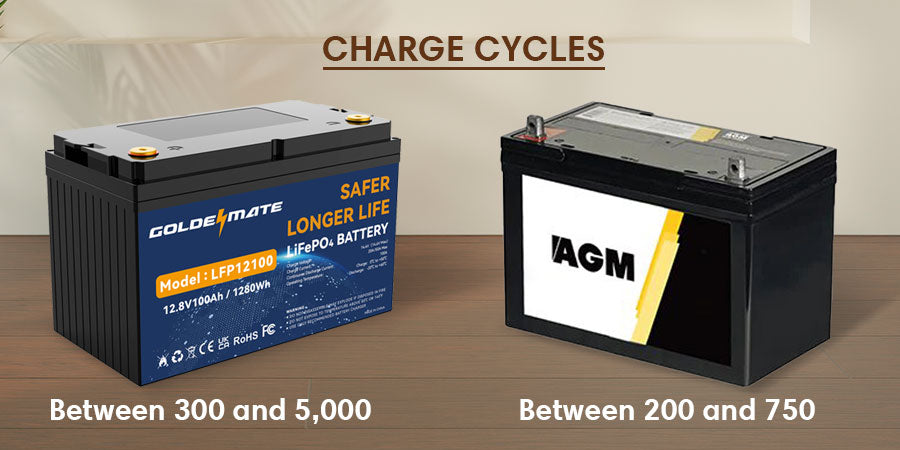
| AGM (Lifeline, Optima, Odyssey) | $270 – $400 | 300 – 660 cycles | $0.41 – $1.33/cycle |
| Lithium (Relion, Epoch, LiTime, Watt Cycle) | $700 – $1,050 | 2,000 – 5,000+ cycles | $0.14 – $0.53/cycle |
Lithium costs 50-65% less per cycle over its lifetime. A cruiser who cycles their house bank daily will replace AGM batteries 3-5 times before a single lithium bank needs replacement. For weekend warriors who cycle less frequently, AGM's lower upfront cost may make more financial sense.
The Catch: System Upgrades Required for Lithium
Before you order lithium batteries, understand that LiFePO4 is not always a simple drop-in replacement for a house bank. Here's what typically needs to change:
Charging System
AGM batteries work with virtually any marine charger and standard alternator. Lithium requires a lithium-compatible charger with the correct charge profile. Most modern inverter/chargers (Victron, MasterVolt, Magnum) have lithium settings — but older units may need replacement or reprogramming.
Alternator Protection
This is where DIY lithium conversions go wrong. Lithium batteries accept high sustained charging current for extended periods — they don't taper off like AGM. A standard marine alternator running at full output for 30+ minutes will overheat and fail. The fix: install a high-capacity alternator paired with a smart external regulator (Balmar, Wakespeed) that manages temperature and output. Budget $800-$1,500 for this upgrade.
Battery Management System (BMS)
Every lithium bank needs a BMS — either internal (built into each battery) or external. The BMS balances cells, prevents overcharge/overdischarge, and protects against charging in freezing temperatures. Quality brands like Relion, Epoch, and Watt Cycle include robust internal BMS units. Budget batteries with weak BMS are the #1 source of lithium problems we see in the field.
Pro Tip: Budget an additional $1,500-$3,000 for the charging system upgrades when planning a lithium conversion. The batteries themselves are only part of the cost. We handle the full conversion — batteries, charger, alternator, BMS integration — as a single project. Our maintenance programs include annual battery system inspections to catch issues early.
The Bottom Line: Which Should You Choose?
AGM is the right choice if: you use your boat occasionally (weekends, holidays), have minimal electrical needs (basic lights, radio, small fridge), want a simple plug-and-play installation, and are working within a tight budget. Quality AGM brands we install: Lifeline, Optima, Odyssey, and Interstate.
Lithium is the right choice if: you cruise long-range or liveaboard, run high-draw appliances (air conditioning, watermaker, trolling motors, heavy audio), want to cut generator runtime by 70%+, or care about weight savings. Lithium brands we install and trust: Relion, Watt Cycle, Epoch, and LiTime.
Not sure which direction to go? Use our Battery Comparison Tool to see specs side-by-side, or our Battery Selector to get a recommendation based on your vessel and usage. Or just call us at 239-323-9600 — we'll walk you through it.
Frequently Asked Questions
Q: Can I mix lithium and AGM batteries on the same boat?
A: Yes, and it's actually a common setup. Many boaters use lithium for the house bank and keep AGM for the starting battery. The two systems should be isolated — never parallel lithium and AGM in the same bank. A battery combiner or ACR (Automatic Charging Relay) keeps them separated while allowing the alternator to charge both.
Q: How long does a lithium house bank conversion take?
A: A straightforward swap (batteries + charger reprogramming) takes 4-6 hours. A full conversion including alternator upgrade, external regulator, and BMS integration typically takes 1-2 days. We handle these regularly at docks across Fort Myers, Cape Coral, Naples, and Marco Island.
Q: Will lithium batteries work with my existing Victron system?
A: Almost certainly yes. Victron inverter/chargers, solar controllers, and battery monitors all have native lithium LiFePO4 profiles. If you're already running Victron, the conversion is significantly simpler. See our Victron Energy page for compatible configurations.
Q: Are lithium marine batteries safe on a boat?
A: LiFePO4 (lithium iron phosphate) is the safest lithium chemistry available — it does not experience thermal runaway like lithium-ion (Li-ion) batteries used in phones and laptops. Quality marine LiFePO4 batteries from Relion, Epoch, and Watt Cycle are UL-listed and ABYC-compliant. The key is buying from reputable brands with proper BMS — not the cheapest option on Amazon.
Q: What's the warranty on lithium vs AGM marine batteries?
A: Most quality AGM batteries carry 1-3 year warranties. Lithium batteries from the brands we install carry 5-10 year warranties: Relion (10 years), Epoch (8 years), LiTime (5 years), Watt Cycle (5 years). The warranty alone often outlasts the total lifespan of multiple AGM replacements.